VR Perceptual Training in Ice Hockey
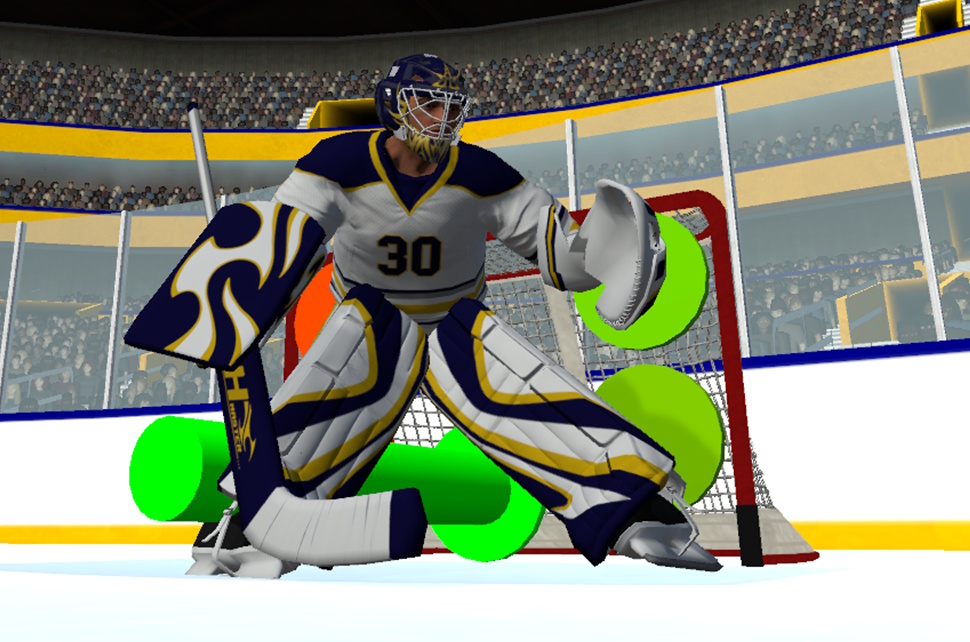
A virtual reality simulator designed to train the perceptual ability of ice hockey players to identify the Largest Exposed Area (LEA), i.e., the goal area least covered by the goaltender from a puck perspective.
Key challenge addressed: the puck viewpoint differs from the eyes viewpoint. Yet, scoring requires the puck to cross the goal line. Therefor, players must learn to “see through the eyes of the puck”
Key features:
- 34 professional Swiss National League players tested
- Pimax 5K XR headset with 200° diagonal field of view
- Multiple approach angles (±5° to ±45°) and shooting distances (3.5–7.5 m)
- Visual feedback combining color-coded targets and a unique puck-view perspective
- Virtual goaltender animated from motion-captured movements of a professional Swiss National League goalkeeper
AR Penalty Kick Simulator

An augmented reality simulator to assess and train the sensorimotor skills underlying penalty kick success, specifically, the ability to redirect the kick based on the goalkeeper's anticipatory movements.
Players kick real balls toward a real goal on a real pitch, but face a holographic goalkeeper displayed through a Microsoft HoloLens 2 headset. This unique setup combines the ecological validity of real-world kicking with the experimental control of virtual environments.
Key features:
- 13 elite youth players (U16–U18, FC Basel & FC Luzern) tested, 8 Swiss national team players
- The holographic goalkeeper's dive is triggered in real time based on the player's run-up kinematics
- Machine learning algorithms (Bayesian network) dynamically adjust task difficulty to optimize learning rate
- Goalkeeper animation based on motion-captured movements of a professional goalkeeper
- LIDAR sensor (240 Hz) for precise foot-ball contact timing
Slap-Shot Simulator
A VR slap-shot simulator designed to improve shooting performance in ice hockey using personalized training based on optimization algorithms.
The simulator analyzes the biomechanics of the player's shooting motion and provides real-time feedback to optimize technique. As with the penalty simulator, the virtual goaltender reacts to the player's real movements, creating representative game-like scenarios.
Key features:
- Real-time motion tracking of shooting technique
- Virtual goalkeeper animated from motion-capture recordings of a professional goaltender
- Personalized feedback targeting individual technical weaknesses
- Progressive difficulty adjustment based on player improvement
Le Naour, T., Hayoz, L., & Bresciani, J.P. (2020). Human-avatar interaction in virtual environment to assess and train sensorimotor: Application to the slap shot in hockey. International Journal of Virtual Reality, 20(2), 36–54. doi:10.20870/IJVR.2020.20.2.4576
Visual–Kinesthetic Integration in Locomotion
How do visual and kinesthetic/efferent cues interact during locomotion (walking, running)? Do the characteristics of a visual scene affect perceived locomotor speed or perceived effort?
This project investigates the multisensory integration processes underlying the perception of self-motion. Understanding these mechanisms has implications for rehabilitation, sports training, and VR application design.
Setup:
- Athletes walk or run on a treadmill facing a large projection screen (5 × 3 m)
- The speed and visual characteristics of the scene (slope, contrast, optical flow, etc.) are manipulated
- Perceptual judgments (perceived speed, effort) and physiological measurements are recorded simultaneously
Research questions:
- How does visual flow speed influence perceived walking/running speed?
- Can visual manipulations affect perceived exertion?
- What are the limits of visual-kinesthetic recalibration?
Goalkeepers' Perceptual Strategies for the Penalty Kick
What perceptual strategies lead to the best goalkeeping performance? Are certain gaze patterns associated with higher anticipation accuracy? Do expert goalkeepers use different strategies from novices?
This project uses eye-tracking technology to analyze how goalkeepers extract information from a penalty taker's approach. Understanding optimal gaze strategies can inform goalkeeper training protocols.
Setup:
- Goalkeepers observe the run-up of a virtual kicker and attempt to anticipate the kick direction prior to ball contact
- All kickers are virtual avatars animated using real motion-captured movements of semi-professional players
- Eye movements are recorded using integrated eye-tracking
- A lab-developed visualization tool analyzes gaze patterns (fixations, saccades, quiet eye)
Research questions:
- Which body regions provide the most reliable cues for anticipation?
- How does gaze behavior differ between successful and unsuccessful saves?
- Can targeted gaze training improve anticipation accuracy?
Fall Prevention and Detection in Elderly Adults
Falls often result in serious medical complications in aging populations, including fractures, loss of independence, and reduced quality of life. This project aims to define fall-risk indicators that can be monitored routinely at home using ambient sensors, enabling early intervention.
Setup:
- Individuals perform everyday motor tasks (standing up, walking, turning, sitting down)
- A Microsoft Kinect ambient sensor captures their movements without requiring worn devices
- Gait parameters, movement patterns, and balance indicators are automatically extracted
Analysis:
- Machine learning algorithms classify individuals based on fall risk (e.g., low vs high risk)
- Longitudinal tracking detects changes in motor patterns over time
- The system aims to identify at-risk individuals before a fall occurs